About
A brief survey on MSCA Doctoral Networks and their value for industry
MSCA Doctoral Networks are collaborative programs that provide interdisciplinary training and research opportunities for early-stage researchers (ESR), fostering connections between academia and industry. They play a vital role in bridging the gap between academic research and industry needs, benefiting both parties and contributing to societal and economic growth. The value of MSCA Doctoral Networks for industry is significant. The networks foster strong collaborations, enabling knowledge transfer, innovation, and the development of practical solutions. Industry partners can actively participate in the training and supervision of doctoral candidates, sharing their expertise and providing real-world perspectives. The involvement of companies can take various forms, including providing practical insights, offering access to resources and facilities, or participating in co-supervision. Furthermore, ESR visits in terms of so-called secondments are a typical contribution. Remarkably, no financial support is required since this is covered by the academic institutions.
Background and Goals of SecReSy4You
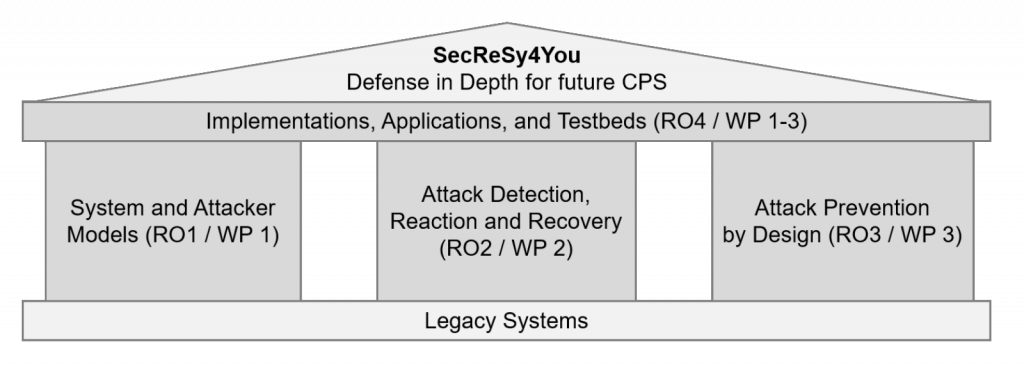
Critical engineered systems are increasingly a target of cyber-attacks that exploit vulnerabilities within digital communications, sensors, actuators or embedded hardware and software. Such attacks can collect sensitive information, cause damage to physical components, and even harm humans.1 According to the World Economic Forum,2 the risk of cyber-attacks is estimated to be second only to environmental disaster. Protecting and bolstering the resilience of critical infrastructures and other Cyber-Physical Systems (CPSs) is a key mission3 of the European Union (EU), through instruments such as the CER4 and the upcoming NIS2 directives.5 Yet there exists a widely acknowledged gap in the number of highly trained security professionals and researchers in both the industrial and academic sector.6 Furthermore, the high complexity of large-scale CPS, which include tightly coupled Information Technology (IT), Operation Technology (OT) and physical components, will demand autonomous and AI-based tools for detection, reaction and recovery.7 The main goal and ambition of the SecReSy4You project is thus to train a future generation of researchers (10 ESRs) in the field of security and resiliency of Cyber-Physical Systems, addressing challenges induced by the multidisciplinary aspects of CPSs, the strategic and adaptive capabilities of current cyberattacks, and the distributed large-scale nature of critical CPSs. Under the guidance of leading academic institutions, research institutes and industrial partners, the ESRs will collaborate to develop cutting edge solutions for modelling advanced threat actors, detecting and reacting to them and ultimately designing AIbased control and monitoring systems that will provide CPS with the highest level of protection and resiliency for today’s and future scenarios. ESRs will acquire technical and transferable skills through an intensive doctoral training program designed upon intersectoral and interdisciplinary needs from both academia and industry, making their future career ready to thrive in a continuously evolving environment.